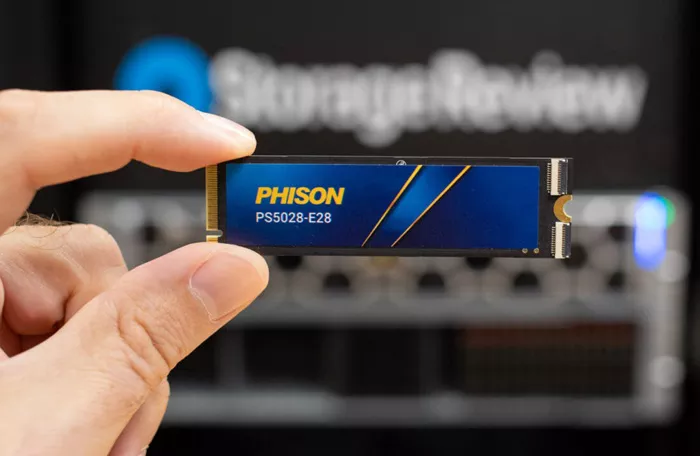
Phison Electronics has unveiled a new AI memory expansion technology called aiDAPTIV, designed to increase effective working memory for local artificial intelligence tasks by combining system RAM with high-reliability NAND flash storage through its Pascari aiDAPTIV Cache Memory technology. The company says this solution helps reduce dependence on large RAM configurations, enabling more complex AI models to run directly on consumer and enterprise PCs.
According to Phison Electronics internal testing, the aiDAPTIV system enabled running a 26-billion-parameter model on a device with 16GB of RAM, whereas such tasks typically require 32GB without this technology. The improvement was achieved through methods such as KV cache reuse and memory offloading, which extend effective AI working memory beyond physical RAM limitations.
The technology is being developed in collaboration with Intel and optimized for AI PC platforms running on Intel Core Ultra processors. It also integrates support for the OpenVINO toolkit, enabling developers and independent software vendors to more efficiently evaluate and deploy AI workloads on local devices.
Executives from both companies emphasized that AI PCs are evolving into systems capable of running increasingly complex agentic applications and mixture-of-experts models, placing higher demands on memory and responsiveness. KS Pua, CEO and founder of Phison Electronics, said the goal is to enable OEMs, developers, and end users to run larger AI models locally, preserving privacy and reducing infrastructure costs.
At Computex, Phison is expected to demonstrate aiDAPTIV-enabled systems running on Intel AI PC platforms. These demonstrations will include a local chat interface running on a MoE model that typically exceeds system memory limits, showing how the technology extends usable AI memory without the need for additional DRAM.
The company will also showcase a hybrid AI routing application built on OpenClaw, demonstrating how local models can be combined with cloud services for optimized inference. Partners including LLMWare and TurinTech AI highlighted the benefits of running AI workloads on consumer hardware, while LLMWare emphasized the growing demand for on-device enterprise workflows such as retrieval-augmented generation and specialized agents. TurinTech AI added that combining AI optimization tools with improved memory architecture can help move more practical AI workloads directly to PCs.
Intel's leadership in client computing also emphasized that users and businesses increasingly want faster and more private AI experiences without excessive dependence on cloud infrastructure. The collaboration with Phison is aimed at enabling larger models to run locally with simpler system configurations, improving both cost efficiency and data privacy.
Overall, aiDAPTIV positions itself as a bridge between hardware limitations and the growing demands of modern AI workloads, especially as PCs evolve into full-fledged AI computing platforms.