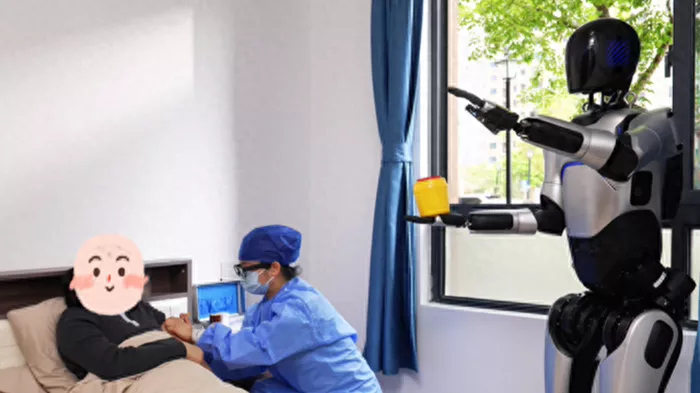
In Shanghai’s Jinshan District, a new form of “human–robot collaborative” home healthcare has been put into real-world practice, marking what local institutions describe as the country’s first integrated scenario of its kind.
An elderly diabetes patient, Zhang Abo (a pseudonym), recently received wound dressing care at home without needing to travel. Her treatment was carried out by a medical team from Fudan University Affiliated Jinshan Hospital, supported by a life-sized embodied AI robot known as “Jin Xiaoyi.”
The robot, developed through secondary engineering based on a mature domestic platform, accompanied nurses during the visit while carrying a small medical kit. Upon arrival, it assisted in environmental disinfection under staff instructions, and used high-definition cameras to capture real-time images of the patient’s foot wound, transmitting data back to the hospital’s remote monitoring system.
Meanwhile, clinicians at the hospital utilized 5G-enabled AR glasses to connect with specialists in real time, enabling remote ultrasound assessment of vascular conditions and providing immediate clinical guidance during the procedure. The robot also continuously recorded the entire care process, updating medical records and supporting health education for the patient.
Beyond assisting with basic tasks such as disinfection, logistics, and data recording, “Jin Xiaoyi” also interacted with the patient directly, reminding her to monitor blood glucose levels and follow rest recommendations. After the procedure, it automatically organized medical supplies and provided follow-up guidance based on updated care plans.
Medical staff involved in the visit noted that the robot significantly reduced their workload in routine operations, allowing them to focus more on precision treatment and patient communication.
The initiative is part of a broader effort led by Fudan University Affiliated Jinshan Hospital in collaboration with the Shanghai Hongqiao Silver Economy Research Institute and the Shanghai (Fudan University) Cooperation Development Research Center. The program aims to address mounting challenges in chronic disease management and aging populations by bringing high-quality medical resources directly into patients’ homes.
Hospital leadership said the approach helps reduce transportation burdens, caregiver dependency, and unnecessary hospital admissions, while improving efficiency in primary care delivery. It also strengthens a tiered healthcare system by supporting “first-contact care at the community level” and enabling two-way referral pathways between primary and higher-level hospitals.
To further advance the system, Jinshan Hospital has established a smart home diagnosis and robotics training base, as well as a medical-engineering joint laboratory focused on home healthcare robotics. These platforms are designed to support simulation training, clinical standardization, and rapid iteration of medical robot applications.
Experts from academic and policy institutions, including representatives from Shanghai medical governance research bodies, said the model aligns with China’s ongoing push for integrated care reform and could serve as a replicable framework for future healthcare innovation, provided that AI-clinical integration and human–machine collaboration training are further strengthened.