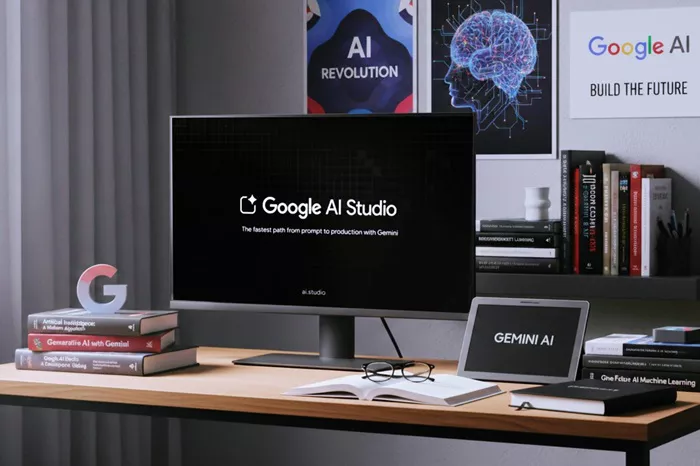
Google is pushing deeper into what some in the tech industry call “vibe coding,” expanding its effort to make app development accessible through natural-language prompts. On Tuesday, the company announced a major update to Google AI Studio, allowing users to generate native Android applications using simple prompts. The generated apps are built in Kotlin and rely on Jetpack Compose, which has become the standard for modern Android interfaces.
The new workflow is designed to lower the barrier to mobile development, especially for users who may not be familiar with traditional tooling. Instead of starting directly in Android Studio, users can now prototype directly in a browser-based environment, generate an app through prompts, and immediately test it on a device or emulator. Google emphasized that the system is powered by the same underlying technology used in Android Studio’s Gemini integration, and now also supports a broader range of large language models beyond just Gemini.
Once an app is generated, users can install it on an Android device for testing or import it into Android Studio for further refinement and preparation for production release. AI Studio also includes a built-in Android emulator, enabling quick previews without additional setup. For real-device testing, users can connect an Android phone via USB, with the Android Debug Bridge handling deployment and communication between the tool and the device.
Google highlighted that this approach is not limited to basic UI generation. Developers can tap into core mobile hardware features such as GPS, Bluetooth, NFC, and other sensors, enabling more complex, device-aware applications. In one example, Google demonstrated how a prompt could generate an aviation-style dashboard on a Pixel Watch, pulling data from onboard sensors like the gyroscope and GPS to simulate flight instrumentation.
While the company positions this as a bridge between simplicity and production-grade development, it also underscores a broader shift in software creation. Web-based prototyping has become increasingly common, but Google is now attempting to bring the same immediacy to mobile development—an area that has traditionally required more technical setup and expertise.
Google says the goal is to combine the ease of prompt-based creation with the full power of the Android ecosystem, giving both beginners and experienced developers a faster path from idea to working application.