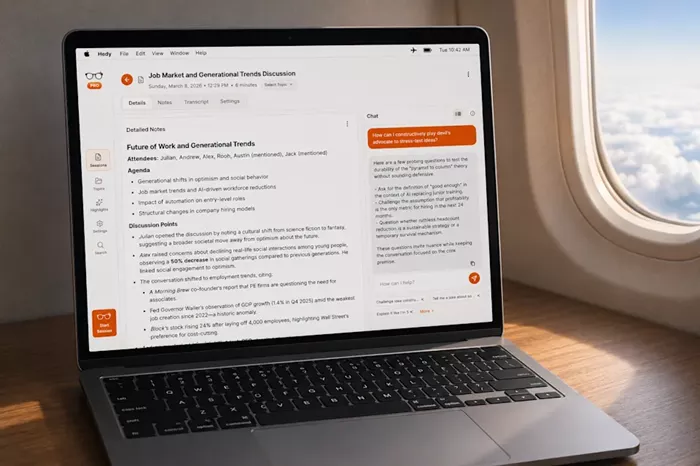
Hedy AI has introduced a new “Local AI Processing” feature that allows professionals to run its full artificial intelligence pipeline directly on their own devices, eliminating the need to send conversation data to external servers.
The company announced the update on May 13, 2026, describing it as a privacy-focused shift designed for users working in sensitive environments where cloud-based AI tools have traditionally been restricted.
The new capability enables meeting transcripts, automated summaries, detailed notes, conversational replies, and Hedy’s real-time coaching features to be processed entirely on a user’s laptop or smartphone. According to the company, all computation happens locally on the device that records the conversation, and no audio or text data is transmitted to remote servers. The feature is opt-in and disabled by default, allowing users to choose between on-device processing and traditional cloud-based workflows.
Hedy AI said the update is aimed at professionals whose work involves highly confidential information. These include legal practitioners handling attorney-client privileged discussions, journalists working with sensitive sources, medical professionals documenting patient consultations, and consultants or coaches managing private client interactions. The company also highlighted benefits for users in low-connectivity environments, where reliable internet access is not always available.
The release reflects a broader shift in the AI industry, where improvements in model efficiency and hardware performance are enabling advanced AI workloads to run locally on consumer devices. Over recent years, smaller open-weight models and increasingly powerful laptops and mobile chips have narrowed the gap between cloud-based and on-device AI capabilities. Hedy AI positions its Local AI Processing system as part of this trend, bringing real-time meeting intelligence and coaching tools into an offline-first environment.
By moving sensitive processing away from centralized servers, the company is also responding to growing concerns around data privacy, compliance requirements, and corporate security policies that limit the use of external AI services. The update signals a competitive push toward privacy-preserving AI systems that maintain functionality while reducing exposure of user data.